The Comeback Calibre: Jack Draper’s Return to Wimbledon, Measured in Time and Resilience
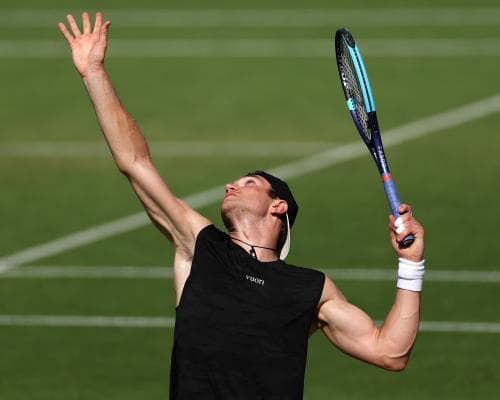
There is a particular kind of silence that follows a champion’s absence — a hush that settles over Centre Court when a name once etched in the draw is suddenly missing. For Jack Draper, that silence stretched across twelve months, punctuated by the cruel tick of a clock that measured not match points but months of rehabilitation. Twelve months ago, he was the rising sun of British tennis, ranked a career-high No. 4 after claiming his first Masters 1000 title at Indian Wells. Now, as he steps onto the hallowed grass of Wimbledon, the air around him carries the weight of a movement restarted — not with a spring, but with the slow, deliberate unwind of a mainspring finding its tension again.
The object here is not a watch, but the metaphor is inescapable: Draper’s return is a chronograph of resilience. The injury — a bruised humerus — was a ghost in the machinery, forcing him to withdraw from last year’s US Open and miss the Australian Open entirely. A subsequent knee problem then stole his spring, scratching him from the French Open. “It wasn’t easy, especially not watching tennis,” he says. “I just had to stay away from it. It would wind me up to watch tennis because I wanted to be out there.” That self-imposed exile is the hallmark of a collector who knows when to set a piece aside, to let it rest, to protect its integrity. The body, like a fine calibre, demands patience.
What Draper did in that quiet year is the stuff of horological legend: he worked on the invisible — the mental side, the psychological balance. “I spent a lot of time working on other areas of my tennis, like my mental side. I didn’t stop physically. I tried to stay as fit as I could because that’s the thing — you never know when you’re going to turn the corner.” This is the craftsmanship of the unseen: the polishing of a balance staff, the adjustment of an escapement. He returned only last week in Eastbourne, reaching the semi-finals — a movement that, after months of stillness, began to beat again with purpose. The significance is not merely in the result but in the restoration.
In the world of high horology, rarity is often a function of what is withheld. A limited edition is defined by how many are not made. Draper’s year away from the tour is his own limited edition — a period of scarcity that makes his return all the more valuable. “Coming here last year as four in the world, I was feeling incredible and looking forward to everything that was to come. I felt like I was gradually building up and up and up, confidence in my tennis, in my body, in my mind. Then you have something that stops you in your tracks when you’re not expecting it. It’s really difficult to accept that.” The collector understands this: the most prized pieces are those that have survived a journey, that carry the patina of struggle.
For the ultra-wealthy who follow Wimbledon from the Royal Box, Draper’s narrative is a lesson in taste. True luxury is not the uninterrupted ascent but the graceful recovery — the ability to step away, recalibrate, and return with a deeper understanding of one’s own mechanics. He speaks of compromising: “I was using gut strings, changing different areas in my game, practising hardly at all. Now I’m in a position where I’ve got…” The sentence trails off, but the meaning is clear. He has found his beat again. The market for such stories is insatiable; the connoisseur craves authenticity forged in adversity.
As Draper faces Taylor Fritz on the grass, the watch world will be watching not just the score but the timing. Will the movement hold? Will the amplitude remain steady? The answer lies in the coming fortnight, but the message is already clear: the most exquisite timepieces are those that have been stopped and restarted, their hands sweeping forward with a quiet authority that only patience can bestow. In a world that demands immediacy, Jack Draper has reminded us that the finest things — like a perfectly tuned chronograph — are worth the wait.


