The Court of Refinement: Novak Djokovic’s Wimbledon Masterclass in Precision and Power
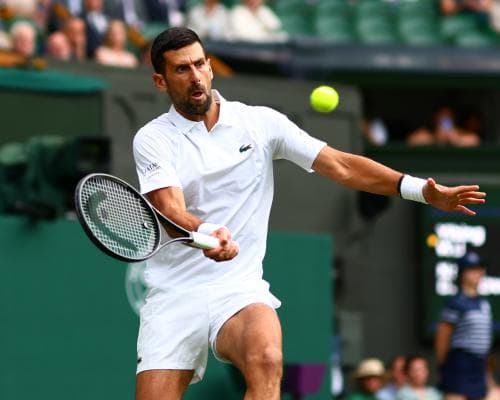
There is a certain hush that falls over Centre Court when a champion of Novak Djokovic’s calibre steps onto the turf—a silence not of anticipation but of reverence. On the first day of Wimbledon 2026, that hush was punctuated by the crisp thwack of a Dunlop ball meeting gut strings, a sound as familiar to the Wimbledon cognoscenti as the pop of a Champagne cork at the members’ enclosure. Djokovic, the ageless sorcerer of baseline geometry, faced China’s Wu Yibing, a player whose raw power has drawn comparisons to a young Juan Martín del Potro. Yet what unfolded was less a battle than a seminar in controlled aggression, a lesson in how the ultra-wealthy might approach any pursuit: with patience, precision, and an unerring eye for the decisive moment.
The significance of this encounter extends beyond the scoreline. Djokovic, now in his late thirties, represents a lineage of champions who have redefined what is possible on grass—a surface as temperamental as a hand-stitched silk tie. Wu, ranked 102nd in the world, arrived with a forehand that could flatten a brick wall and a serve that elicited gasps from the crowd. Yet Djokovic’s early break in the first set was a reminder that true mastery is not about brute force but about geometry and timing. The Serbian’s ability to redirect Wu’s pace, to turn a 120-mph rocket into a gentle passing shot, is the athletic equivalent of a bespoke suit: it appears effortless only because the craftsmanship is invisible to the untrained eye.
The craft of Djokovic’s game is a study in rarity. His racket, custom-weighted and strung at a tension known only to his inner circle, is a tool as bespoke as a Patek Philippe perpetual calendar. His movement—those sliding splits on grass that would shred lesser knees—is a product of years of biomechanical refinement, a process as meticulous as the restoration of a 1962 Ferrari 250 GTO. On this day, Wu’s power was undeniable: a forehand that drew a nod of appreciation from Djokovic himself, a slip-and-strike winner that had the crowd rising. But the young Chinese player’s wayward moments—a shot sprayed wide, a double-fault at a crucial juncture—revealed the chasm between potential and polish. Djokovic, by contrast, never deviated: his service games were clinics in efficiency, his returns a masterclass in anticipation.
For the collector of rare experiences, Wimbledon’s first day offered a microcosm of the luxury market’s current appetite for authenticity. While Coco Gauff walked out on Court 2 and Barbora Krejcikova dispatched Britain’s Hannah Klugman in straight sets, the real drama was in the margins: Mimi Xu’s defeat to Daria Kasatkina marked the eighth consecutive loss for British players—a statistic that whispers of a systemic failure in grass-court development. In the world of high-end automobiles, this would be akin to Aston Martin struggling to produce a V12 that passes emissions. The lesson for the discerning observer is that pedigree alone does not guarantee performance; it requires infrastructure, investment, and a willingness to evolve.
What Djokovic’s opening act signals about luxury taste is this: the true connoisseur values endurance over flash. In an era of hypercars that boast 0–60 in under two seconds, there is something profoundly satisfying about a machine—or a man—that can sustain peak output over two decades. Djokovic’s game is not about the highlight-reel winner; it is about the grinding, methodical dismantling of an opponent’s will. This is the same philosophy that drives the market for vintage Porsches over new Ferraris, for single-malt Scotch over trendy mezcal. It is a taste for the refined, the proven, the timeless.
As the sun dipped over the ivy-clad walls of the All England Club, Djokovic’s path forward remains uncertain—a five-set thriller against Sinner looms, and the young Italian’s power could test even the Serbian’s resilience. But for those who were present, or who watched from a private box with a glass of Krug Grand Cuvée in hand, the memory was indelible: a master at work, a canvas of green and white, and the quiet assurance that some things—like a perfectly struck backhand down the line—never go out of style.


