A $3.3M Airport Slot Hit: What Vegas Jackpots Tell Us About Risk, Liquidity, and the Wealthy's Game
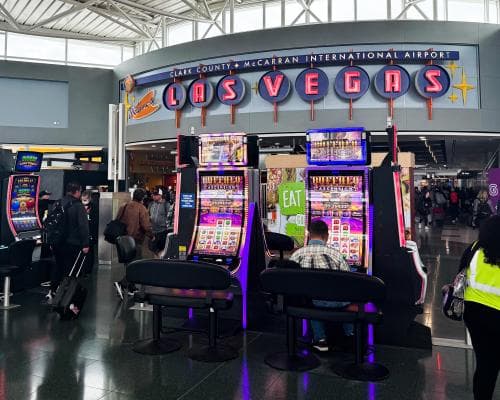
For most people, a layover in Las Vegas means overpriced coffee and fluorescent lighting. For one traveler named Anthony, it meant a $3.3 million payday. The jackpot, hit Sunday at Harry Reid International Airport on a Wheel of Fortune Gold Spin Triple Red Hot 7s slot machine, is the kind of headline that reads like a Vegas marketing stunt — except the payout is real, the tax treatment is favorable, and the market signal is worth more than a passing glance. When a single $10 wager can yield a return of 33,000-to-1, the event stops being a mere curiosity and starts being a case study in how extreme risk is priced, captured, and monetized by the people who design the machines.
The scale of the win is notable not just for its size but for its venue. Airport slot machines are often dismissed as low-stakes diversions for bored travelers. Yet this is the third seven-figure airport jackpot in Las Vegas in 2025 alone: a $1.8 million hit in May, a $348,507.71 win in September, and now this $3.3 million score. The machine was supplied by International Game Technology (IGT), a global gaming giant with a market capitalization of roughly $5 billion. IGT confirmed the winner's name and the specifics: a $10 bet triggered the progressive jackpot on a game that blends mechanical reels with a digital bonus wheel. The mechanics matter because they reveal how gaming companies engineer volatility. Progressive slots pool a portion of every bet into a growing prize, creating a payout structure that behaves like a long-dated, high-delta option — rare to hit, but life-changing when it does.
The numbers behind the payout are instructive. The IRS mandates a 24% automatic withholding on gambling winnings over $5,000, meaning Anthony will see roughly $2.5 million upfront, with the rest subject to his annual tax filing. Nevada, however, imposes no state income tax and no tax on gambling winnings, so the effective tax rate on this windfall will be significantly lower than what a comparable capital gain would face in California or New York. That tax asymmetry is not lost on high-net-worth individuals who maintain second homes or travel frequently through Nevada. For a player in the top federal bracket, the after-tax haul on a $3.3 million slot win is roughly $2.2 million — versus perhaps $1.8 million on a similar investment gain in a high-tax state. The difference is real money, and it's one reason Las Vegas remains a gravitational center for discretionary capital.
This event also signals something about the current appetite for risk among the wealthy and the aspirational wealthy alike. In a market environment where the S&P 500 has delivered a 25% annual return and bond yields have stabilized near 4.5%, the opportunity cost of chasing a slot jackpot has actually declined. When risk-free rates were near zero, a $10 bet on a long-shot payoff felt like a waste. Now, with cash yielding 5% and equity volatility suppressed, the marginal utility of a speculative gamble — whether in a casino or a meme stock — has risen. The airport jackpot is a microcosm of a broader trend: capital is hunting for asymmetric outcomes, and the gaming industry is the purest expression of that hunt. IGT's stock, up 18% year-to-date, reflects that investor appetite for companies that monetize probability.
For the wealth desk, the takeaway is not to recommend slot machines as an asset class. It is to recognize that the same mathematical principles that govern progressive jackpots — pooled risk, high variance, tax-optimized payouts — are being repackaged in everything from structured notes to SPAC warrants to crypto airdrops. The wealthy have always understood that the best deals are the ones where the house doesn't hold all the edge. Anthony's $3.3 million win is a reminder that in a world of compressed spreads and crowded trades, the biggest alpha sometimes comes from the most improbable places. The next time you walk through a Vegas terminal, consider this: the slot machine is not just a game. It is a market.
Looking ahead, the trend of high-dollar airport jackpots is unlikely to slow. As air travel volume recovers to pre-pandemic levels and Las Vegas continues to draw both tourists and business travelers, the probability of another headline-grabbing win is mathematically increasing. For IGT and its competitors, these events serve as free marketing — a $3.3 million payout generates far more media value than a comparable advertising budget. For the traveler, the calculus remains simple: a $10 bet, a 33,000-to-1 payoff, and a tax-advantaged state. For the rest of us, it is a reminder that tail risk, properly managed, can still produce the kind of returns that no balanced portfolio can match.


