The Drone That Sees Through Trees: Why the UK’s £5bn Bet Is Already Too Late
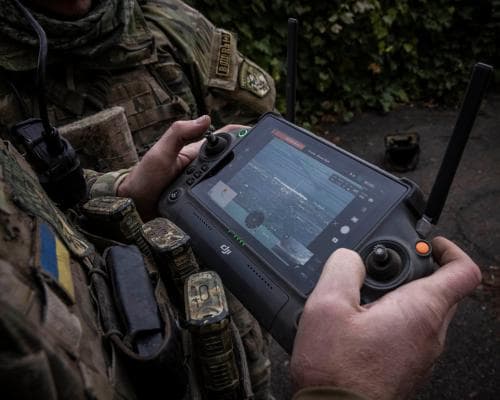
Imagine a soldier moving through a forest, thinking the dense canopy hides him. On a screen in a hidden bunker, a group of young men watch him. They see everything. The drone’s fibre-optic tether, thinner than a charging cable, feeds back a crystal-clear signal through the trees. No GPS jamming can touch it. No electronic warfare can sever it. The soldier realises he’s been spotted. The screens go blank. The drone explodes.
This is not a video game. It is the daily reality in eastern Ukraine, where both sides have turned the front line into a laboratory for the future of combat. The hero of this new age is not a stealth fighter or a nuclear submarine. It is the fibre-optic first-person drone — a cheap, agile, tethered machine that can fly into the most hardened electronic warfare environment and still deliver a kill. The implications are staggering. Expensive tanks, multi-million-pound logistics convoys, even fortified bunkers: all are now vulnerable to a piece of kit that costs less than a used car.
Outgoing UK Prime Minister Keir Starmer announced an extra £5bn for drones across land, sea, and air, ahead of next week’s Nato summit in Turkey. It sounds like a lot. But listen to the experts who have been watching this war from the ground. Senior international correspondent Luke Harding, who has reported extensively from Ukraine, told me that the UK is still thinking in terms of old paradigms — big platforms, long development cycles, and procurement systems that take years to deliver. The drone war in Ukraine evolves in weeks. By the time a British tender is awarded, the threat has already shapeshifted.
The technology itself is brutally simple. A first-person drone is essentially a racing quadcopter with a camera and a warhead. The fibre-optic cable, spooled out from the drone, connects it to the operator’s console. No radio signals. No jamming. No detection. The operator flies the drone like a video game, navigating through windows, trenches, and tree lines. The cable can be kilometres long. Once the target is acquired, the drone dives. The explosion is final. This is not science fiction. It is happening now, in the mud and snow of the Donbas, and it is changing the calculus of every defence ministry in the world.
The capital flowing into this space is enormous. Venture funds that once chased software unicorns are now pouring money into small, agile defence startups. Andover, Anduril, and a dozen European firms are racing to build the next generation of autonomous drones. But the UK’s approach remains cautious. £5bn spread across three domains over several years is not the kind of urgent, flexible spending that wins wars. It is the kind of spending that builds committees. Meanwhile, the Ukrainians are 3D-printing drone frames in basements, iterating on designs weekly, and deploying them by the hundreds.
What does this mean for the broader defence sector? The era of the expensive, exquisite platform is ending. A single $10 million tank can be destroyed by a $500 drone with a $200 warhead. The math is brutal. The future belongs to swarms, to cheap, expendable systems, and to operators who can think like gamers. The UK’s military-industrial complex, built on long contracts and even longer timelines, is not built for this pace. The question is not whether Britain will adapt — it must — but whether it can adapt fast enough to avoid falling irreversibly behind.
This is not a warning. It is a verdict. The drone war in Ukraine has already written the playbook for the next decade of conflict. The UK has a choice: fund a few expensive toys that will be obsolete on delivery, or embrace the messy, fast, cheap, and lethal reality of fibre-optic warfare. The young men in the bunker are already there. Britain’s generals are still reading the manual.