Magnus Carlsen’s Four Consecutive Defeats: A Rare Glitch in the Algorithm of Genius
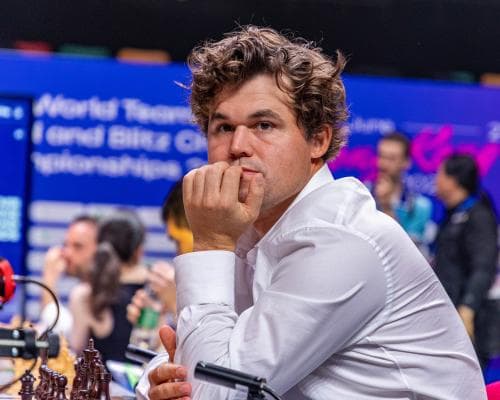
In the rarefied air of elite chess, where every move is a negotiation between genius and entropy, Magnus Carlsen has long been the undisputed sovereign. Yet last week, in the gilded ballroom of Hong Kong’s Grand Hyatt, the 35-year-old Norwegian experienced something his followers had not witnessed since he was eleven years old: four consecutive defeats. For those who track the trajectories of the ultra-wealthy’s most cerebral pastimes, this is not merely a sporting anomaly—it is a signal. A signal that even the most finely tuned human machine may be recalibrating its priorities.
The four losses unfolded with the dramatic inevitability of a Greek tragedy. Carlsen began the World Team Rapid with characteristic brilliance, drawing one game and then dispatching the Ukrainian legend Vasyl Ivanchuk with the kind of prolonged, grinding technique that has become his signature—a style that collectors of chess artistry compare to a vintage Patek Philippe chronograph, precise, relentless, and beautiful under pressure. He followed with a victory against China’s Xu Xiangyu, cementing his early dominance. But then the narrative fractured. Against India’s Arjun Erigaisi, world No. 8, Carlsen faced a ferocious king-side attack culminating in a queen sacrifice—a move so audacious it would be unthinkable against anyone but a champion. The next round, chasing a win in a drawn endgame against Armenia’s Shant Sargsyan, Carlsen blundered his rook in a single, uncharacteristic move. Two more losses followed, against Javokhir Sindarov, the Candidates winner, and others, leaving the chess world in a state of hushed disbelief.
For the luxury-obsessed observer, the significance lies not in the losses themselves but in what they reveal about the cost of sustained excellence. Carlsen, now a father to a baby son and a man of considerable wealth—his net worth is estimated in the tens of millions, with sponsorships from luxury watchmakers and fintech brands—has been openly contemplating a reduced schedule. His disappointing fourth-place finish among six grandmasters in Oslo last month only amplifies the speculation. The four defeats in Hong Kong, his first such streak since Gausdal 2002, are the statistical equivalent of a Ferrari stalling on the starting grid: rare, jarring, and deeply human. They whisper of fatigue, of distraction, of the gravitational pull of a life less consumed by the board.
In the world of high-end collecting, rarity is the ultimate currency. Carlsen’s losing streak, like a misprinted stamp or a flawed diamond, is valuable precisely because it is so uncommon. For the ultra-wealthy who sponsor chess events and acquire memorabilia—signed boards, annotated scoresheets, even the watch Carlsen wears during play—this moment adds a layer of narrative complexity to his legacy. No longer simply the invincible champion, he becomes a figure of vulnerability, and vulnerability in a master is a rare and coveted thing. The market for Carlsen’s artifacts, already buoyant, may see a spike in interest as collectors seek to own a piece of this fleeting imperfection.
Yet even if Carlsen were tempted to withdraw from top-level competition, the calendar forbids it. In early August, he travels to Paris to defend his title at the Esports World Cup, an event whose scheduling has been criticized as disrespectful to the Sinquefield Cup, the premier event of the Grand Chess Tour. The tension between obligation and desire is palpable. For the connoisseur of luxury lifestyles, this is the ultimate dilemma: how to balance the demands of a world that worships your genius with the quiet allure of a life spent in slower, more deliberate pursuits. Carlsen has already hinted at a future beyond the board—investments in tech startups, a passion for fine wine, and the joys of fatherhood. The four defeats in Hong Kong may not be the beginning of a career downturn, but they are a reminder that even the greatest champions are allowed to recalibrate.
What this signals about luxury taste is a shift in values: the ultra-wealthy are increasingly drawn not to unbroken streaks of dominance, but to the stories of those who choose when to step back. The real luxury, after all, is not the ability to win every game, but the freedom to decide which games are worth playing. Carlsen’s four consecutive losses, viewed through this lens, become a kind of quiet manifesto—a declaration that even at the apex of one’s powers, there is a deeper richness in choosing one’s battles wisely. For the readers of The Curated Life, this is the ultimate acquisition: not a trophy, but the wisdom to know when to set it down.


