The Unseen Art of the Knockout: Jaron ‘Boots’ Ennis and the Elegance of Controlled Violence
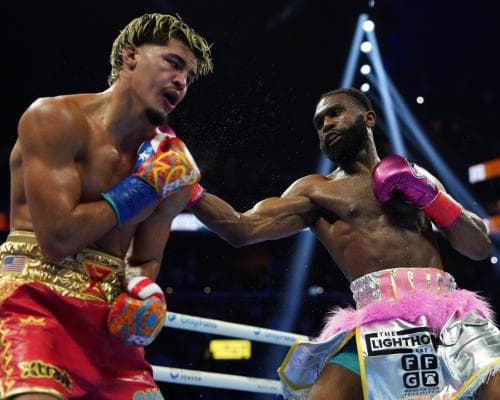
There is a particular kind of alchemy that occurs when a fighter, long whispered about in private circles as a generational talent, finally steps onto the canvas and proves the myth real. On Saturday night at the Barclays Center in Brooklyn, Jaron “Boots” Ennis did not simply win a fight; he curated a moment of such visceral, high-stakes artistry that it will be studied by connoisseurs of the sweet science for years. In the rarefied world of elite sport, where the difference between legend and footnote is measured in milliseconds, Ennis delivered a performance that felt less like a contest and more like a revelation—a seven-round symphony of controlled violence that unified the WBA and WBO super-welterweight titles and cemented his place in the pantheon of the sport’s true artisans.
The significance of this victory extends far beyond the two championship belts now resting on Ennis’s shoulder. For the ultra-wealthy patron who appreciates the scarcity of genuine mastery, Ennis’s path to this moment mirrors the acquisition of a one-of-a-kind masterpiece: years of promise, a patient market, and a single, defining night that recalibrates value. The bout was billed as the year’s most compelling matchup, pitting two undefeated champions whose trajectories had been charted since their teenage years. But where Xander Zayas represented the polished, technically sound product of the modern amateur system, Ennis embodied something far more elemental—a raw, almost primal force refined by years of Philadelphia gym wars. When he dropped Zayas with a straight left late in the first round, the sellout crowd rose not just in celebration, but in recognition: they were witnessing the arrival of a singular commodity.
What separates Ennis from the crowded field of unbeaten contenders is the craftsmanship of his craft. His ability to switch seamlessly between orthodox and southpaw stances, to find openings through a guard that had never before been penetrated, and to absorb Zayas’s furious third-round rally without losing composure speaks to a level of technical sophistication that the casual observer might miss. For the collector who values provenance and heritage, Ennis’s style echoes the great Philadelphian tradition of Joe Frazier and Bernard Hopkins—a lineage of fighters who understood that brutality, when executed with precision, becomes a form of high art. The referee’s stoppage at 1:49 of the seventh round was not an interruption but a punctuation mark, concluding a narrative that had been building for a decade.
In the context of the luxury market, Ennis’s victory represents a recalibration of value. For years, he was the most avoided fighter in the division—a diamond too brilliant for lesser promoters to risk. Now, with a signature win that improves his record to 36-0 with 32 knockouts, his stock has ascended into a stratosphere reserved for the truly elite. The bout’s location at Barclays Center, the epicenter of Brooklyn’s cultural renaissance, only heightened the sense of occasion. This was not a backroom brawl; it was a gala, a gathering of tastemakers who understand that true rarity—whether in a vintage Ferrari, a first-edition Patek Philippe, or a fighter of Ennis’s caliber—demands a stage worthy of its brilliance.
What this victory signals about the current state of luxury taste is subtle but profound. In an era of algorithm-driven curation and mass-market hype, Ennis’s triumph is a reminder that the most coveted acquisitions are those that cannot be manufactured. His post-fight words—“I put on a show for the fans and I appreciated Zayas taking this, because he didn’t have to”—carry the quiet confidence of a man who knows his worth. For the discerning reader of The Curated Life, this is the ultimate lesson: true value lies not in the price tag, but in the story. Ennis’s story is one of patience, risk, and the willingness to step into the fire when others would step aside.
Looking forward, the super-welterweight division has been handed a new sovereign. The unification of the WBA and WBO titles opens the door to a potential undisputed showdown, and the whispers of a megafight with the winner of the division’s other belts are already circulating among the sport’s most influential power brokers. For the collector who missed the chance to buy into the early career of a legend, the window is still open—but it is closing fast. Ennis’s performance was not merely a victory; it was an invitation to witness the forging of a legacy, one that will be recounted in private clubs and boardrooms for decades. The ultimate luxury, after all, is not possession—it is having been there when history was made.


