The Eighth Decade of a Ballet Romance
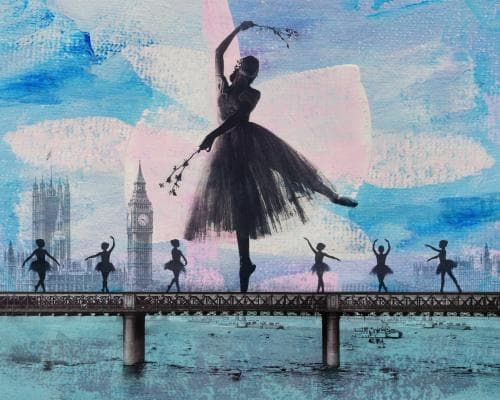
The first time she saw the London Festival Ballet, something shifted. Not a dramatic break, but a quiet tectonic slide — the kind that rearranges the interior landscape forever. She was a young girl in suburban Wimbledon, and the Royal Festival Hall felt like a portal to another world. The iron girders of Hungerford Bridge became the passageway. From the balcony, she watched dancers speak without words, and she understood: the body could say things language could not.
That night, she fell in love. Not with a single dancer or a particular production, but with the whole architecture of it — the fidgety excitement of the audience, the orchestra settling into their chairs, the sudden bloom of colour and sound out of darkness. She began collecting LPs: Mantovani and His Orchestra, An Album of Ballet Melodies. Alone in the living room when her parents were out, she would let the opening bars of Tchaikovsky’s Waltz of the Flowers move through her. It felt natural, as though she were channelling something that had been waiting inside her all along. She was shy, but dancing alone, she felt completely herself.
Decades later, that girl is now in her eighties. The living room has changed, the LP has been replaced by streaming playlists, but the body remembers. She still dances. Not for an audience, not for applause — but for the same reason she first did: because it is liberating. The movements are slower now, more deliberate. The knees protest, the hips remind her of their age. But the rapture remains. She has learned that ballet is not a pursuit of youth; it is a conversation with time. Each plié is a negotiation, each arabesque a small act of defiance against gravity and decay.
What makes her story remarkable is not the nostalgia — we all have that — but the discipline. She has kept the practice alive through decades of change: careers, children, moves, losses. She adapted. When the classes became too demanding, she found gentler ones. When the music felt too fast, she slowed it down. She discovered that ballet’s true luxury is not in the perfect turn-out or the high extension, but in the quiet, private ritual of showing up. It is a form of self-possession that money cannot buy, yet the ultra-wealthy spend fortunes trying to replicate: the feeling of being fully alive in one’s own skin.
In the world of curated living, we often write about objects — the watch that took three years to make, the wine that was aged in a specific cave, the car that is one of twelve. But the rarest thing of all is a practice that sustains you across eight decades. This woman owns no rare artifact; she owns a relationship with her own body, honed over a lifetime. That is the ultimate bespoke item. And it cannot be inherited, commissioned, or insured. It can only be lived.
She still goes to the ballet. The seats are better now — orchestra, not balcony — but the feeling is the same. That moment when the house lights dim and the conductor raises the baton. The darkness, then the illumination. She knows the choreography by heart, but she watches as if for the first time. Because the body still remembers what words cannot say. And in her eighties, she is still learning to speak that language, one careful step at a time.