The Thermostat of Power: How Europe’s Heat Crisis Redefines the Economics of Exclusivity
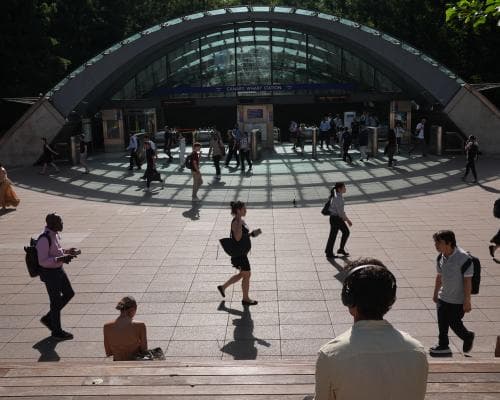
For the global elite, climate control has always been a silent luxury—an invisible amenity that separates the merely comfortable from the truly sovereign. But as June’s record-breaking heatwave grips Yorkshire’s food factories and London’s boardrooms alike, a new calculus emerges: extreme heat is no longer a seasonal nuisance; it is a structural threat to the very engine of European prosperity. For those who command portfolios spanning continents, the question is no longer about air conditioning—it is about how to insulate one’s assets, one’s workforce, and one’s leisure from a climate that refuses to obey old rules.
The numbers are stark, and they demand attention from anyone whose net worth is tied to European output. According to Oxford Economics, temperatures in the high 30s and low 40s Celsius could slash quarterly labour productivity growth by 1.5 percentage points in the UK and up to two percentage points across western Europe. The sectors most exposed—construction, agriculture, manufacturing, retail, and hospitality—represent 27% of UK economic activity and 35% of western Europe’s. Allianz’s research places the cumulative loss for France, Italy, and Spain at $507 billion between 2026 and 2030 under a stress scenario, with France alone forfeiting $240 billion. These are not abstract figures; they are the erosion of GDP that funds everything from private aviation to bespoke architecture.
Yet the true story lies not in the aggregate, but in the granular reality of how privilege adapts. Consider the food factory in Yorkshire, where workers endure temperatures in the high 30s Celsius while producing hot-filled products. The union-negotiated extra breaks are a stopgap, but for the owner of that facility—or the investor whose pension fund holds its equity—the solution is not a fan. It is a multimillion-euro retrofit: geothermal cooling, solar-reflective roofing, and automated climate systems that cost as much as a Gulfstream but preserve both output and brand reputation. The same logic applies to private estates: a château in Provence without a subterranean thermal labyrinth is no longer a trophy; it is a liability. The cost of adaptation is steep, but the cost of inaction is steeper.
What this signals about wealth and taste is a shift from conspicuous consumption to invisible resilience. The ultra-wealthy have long understood that true luxury is not about owning the most, but about controlling the environment. A 30-degree day in London’s financial district is now a test of whether one’s office tower has triple-glazed, spectrally selective glass and a chilled beam system—or whether one’s private club in Mayfair offers a subterranean lounge carved from limestone. The heatwave reveals a hierarchy: those who can afford to decouple their productivity from the weather, and those who cannot. For the discerning collector, this is the new marker of status—not the car, but the climate-proofed garage that keeps it at 18 degrees Celsius.
Looking forward, the implications for the luxury market are profound. Real estate in northern latitudes—Scotland, Scandinavia, the Alps—is already seeing a premium as investors hedge against southern Europe’s thermal stress. Meanwhile, the demand for portable climate control—from personal cooling suits to private-jet cabins with humidity regulation—is surging among those who refuse to let a heatwave interrupt a Monaco-to-Helsinki itinerary. The permanent economic policy challenge that Allianz’s Katharina Utermöhl describes is, for the 0.1%, an opportunity to re-engineer their world. The heatwave is not an exception; it is a direction. And those who can afford to redirect it will inherit the future.
The Experience
For a private consultation on climate-proofing your estate or portfolio, contact our bespoke environmental advisory desk—where thermal resilience meets the art of living well.