The Last Lion of Coventry: Sir Geoffrey Whalen and the Lost Art of Industrial Statecraft
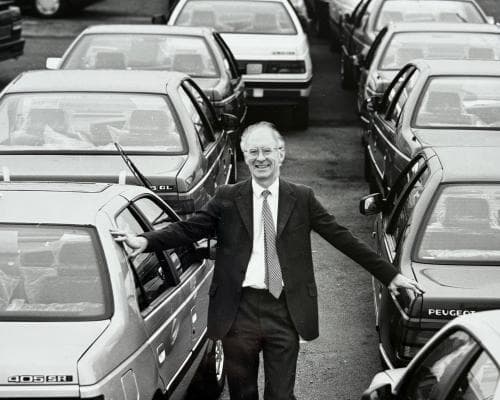
For the ultra-wealthy, provenance is everything. The story behind a possession—the hands that shaped it, the crises it survived—often eclipses the object itself. Yet few narratives in modern industrial history carry the raw, unpolished gravitas of Sir Geoffrey Whalen’s quiet war to keep mass-market car manufacturing alive in Coventry. He was not a designer of coachwork or a titan of finance. He was a fixer of broken systems, a negotiator of chaos, and, in the end, the man who bought Britain’s motor industry two decades it did not deserve. His death at 90 marks the closing of a chapter that wealthy collectors of automotive heritage should study with reverence.
Whalen’s battlefield was British Leyland, the state-backed colossus that swallowed the ailing British Motor Corporation in 1968. By the time he became managing director of Peugeot UK in 1984, the company had already consumed £1.4 billion in government rescue capital—a sum that, adjusted for inflation, would rival a sovereign wealth fund’s pet project today. Whalen arrived at the Cowley plant in Oxford to find a piecework system so fractured that inspectors alone had 80 different pay rates, and the plant averaged two and a half stoppages per day. The Marina, a mass-market car upon which the company’s survival hinged, was threatened by anarchy. Whalen’s weapon was not capital but credibility: he had negotiated with Scottish miners’ leaders like Mick McGahey and understood that discipline, not autocracy, was the antidote to chaos. He introduced daywork, better fringe benefits, and a promise of stability. By 1975, Cowley was the best-performing plant in the group, and the Marina launched on schedule.
But the real rarity here is not the car—it is the man’s method. Whalen’s approach was a form of craft rarely seen in boardrooms today: the craft of industrial diplomacy. He spent eight years under relentless pressure, trying to rationalise a pay system where production workers earned more than skilled toolmakers—a structural absurdity that would make any modern luxury supply-chain manager blanch. When a company-wide bargaining ballot passed in 1977, it seemed Whalen had won. Then the 1978 toolmakers’ strike shattered the fragile peace, and Michael Edwardes was brought in to dismantle Whalen’s centralised system. Whalen walked away, later describing himself as “not psychologically attuned to dismantling all I had been trying to achieve.” That kind of integrity has a price, and in the luxury world, integrity is the rarest commodity of all.
For connoisseurs of automotive history, Whalen’s legacy is a reminder that the most valuable assets are not always the fastest or the most beautiful—they are the ones that survived against the odds. The Marina may never command the auction prices of a Ferrari 250 GTO, but the story of its creation, of a man who kept a factory alive through sheer dogged honesty, adds a layer of provenance that no restoration can replicate. Whalen’s Peugeot years, from 1984 onward, kept Coventry’s production lines humming for an extra 20 years—a feat that, in the context of Britain’s industrial decline, borders on the miraculous. For the ultra-wealthy who collect not just objects but narratives, Whalen’s story is a reminder that the greatest luxury is often the one you cannot buy: the luxury of time, bought with grit.
Today, as the world’s wealthiest seek authenticity in an age of algorithmic taste, Whalen’s quiet heroism offers a counterpoint to the flashy disruptors. He was not a visionary in the Silicon Valley mould; he was a man who understood that the most exclusive thing in the world is a promise kept. The Marina, the Cowley plant, the Peugeot years—these are not headlines from a gala auction. They are footnotes in a story of endurance that should matter to anyone who values how things are made, not just how they are marketed. Sir Geoffrey Whalen’s passing is a call to remember that the true cost of luxury is the human will to preserve it.
The Experience
For a private tour of Coventry’s surviving automotive heritage sites, including the original Cowley assembly line, contact our concierge for an exclusive, curator-led journey through Britain’s industrial aristocracy.