EU Biometric Border Rollout Hits Turbulence: Half-Empty Planes Signal a Crisis of Capacity, Not Technology
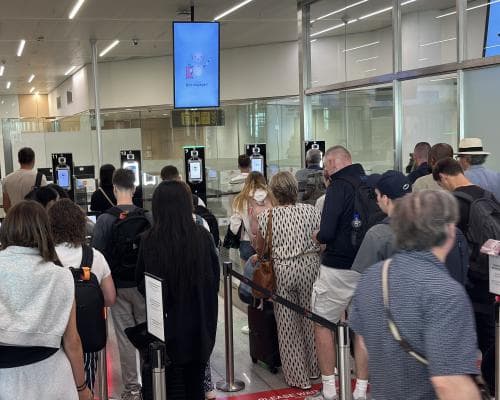
The future of frictionless travel is colliding with the messy reality of concrete and queues. When a cutting-edge biometric border system — designed to replace passport stamps with fingerprint and facial recognition — forces airlines to leave tarmacs with half-empty planes, the problem isn’t the algorithm. It’s the bottleneck where silicon meets steel. The EU’s new Entry/Exit System (EES), rolled out gradually since October, now faces a rebellion from the very industry it was meant to streamline. ACI Europe, Airlines 4 Europe, and IATA have jointly called on European Commission President Ursula von der Leyen to allow airports to “completely suspend” checks when passenger volumes exceed border control capacity. This is not a rejection of AI; it is a warning that even the smartest system fails if the surrounding ecosystem is not engineered for scale.
The technology behind EES is a textbook example of deep-tech ambition: biometric kiosks that capture fingerprints and photographs from non-EU citizens, cross-referencing them against a central database in milliseconds. In theory, this eliminates manual checks, reduces fraud, and enables seamless travel. In practice, the rollout has exposed a classic innovation trap: deploying a high-tech solution without parallel investment in throughput, staffing, and physical layout. The result is chaos. Passengers queue for up to five hours on exposed aprons; airlines watch departure gates close with empty seats because travelers are trapped in biometric purgatory. This is not a failure of AI, but a failure of systems integration — a lesson that resonates far beyond European borders.
The capital and players involved underscore the stakes. The EES is part of a broader €1 billion+ digital border modernization push, funded by EU member states and implemented by tech contractors including Idemia and Thales. Airlines, already operating on razor-thin margins, are absorbing costs from delayed departures and missed connections. The industry groups’ letter is a rare unified front: ACI Europe (airports), Airlines 4 Europe (carriers), and IATA (global aviation) rarely agree on anything, but here they are aligned. They want a “suspension option” during July and August — the peak travel window — arguing that the system’s operational capacity is fundamentally mismatched with demand. The subtext is clear: no amount of AI-powered verification can substitute for enough kiosks, staff, and queuing space.
Market and competitive context sharpens the picture. Globally, biometric border systems are proliferating: the US has its facial recognition exit program, the UK is piloting e-gates, and Singapore’s Changi Airport has fully contactless immigration. But the EU’s scale — 27 countries, hundreds of airports, 700 million annual non-EU visitors — makes it a stress test for the entire sector. If the EES falters publicly, it could slow adoption elsewhere, as governments weigh the political cost of long queues against security gains. Competitors like Veridos and NEC are watching closely; their next-generation systems promise even faster processing, but the bottleneck is now recognized as a physical, not digital, constraint.
What this signals for the sector is a paradigm shift. The era of “deploy AI and forget” is over. The next frontier is not better algorithms, but intelligent infrastructure that dynamically allocates resources — kiosks, staff, queuing lanes — based on real-time passenger flow data. Startups and incumbents alike are racing to build digital twins of airports, using AI to simulate and optimize border throughput before a single kiosk is installed. The EES crisis is a forcing function: it will accelerate investment in adaptive systems that can throttle biometric checks during surges, or reroute passengers to overflow processing zones. The EU’s mistake was treating biometrics as a plug-and-play upgrade; the correction will be treating it as a complex, living system.
Forward-looking, this moment could redefine how deep tech integrates with physical infrastructure. Billionaires and elite capital have poured billions into AI for software, finance, and healthcare. But the hardest problems — like moving millions of humans through a terminal on a Tuesday in August — remain stubbornly analog. The winners in the next decade will be those who bridge that gap: companies that combine facial recognition with predictive queue modeling, or that embed biometric sensors into moving walkways. The EU border fiasco is a $1 billion wake-up call. The technology is ready. The architecture is not. And until that changes, the most advanced AI in the world will still leave planes half-empty.